Tuesday, March 31, 2015

For Your Consideration... Ida


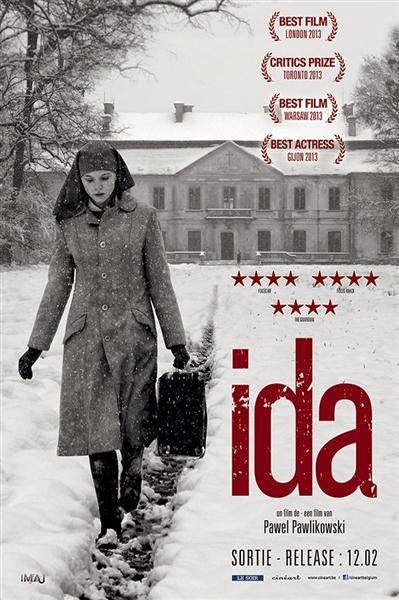
Last month, the Polish co-production (also produced by Denmark, France, and the UK, with support from the Council of Europe film fund, Eurimages) Ida, directed by Paweł Pawlikowski, took home the 2015 Oscar for Best Foreign Language Film at the 87th Academy Awards. Ida beat out one of the favorites, Russia’s Levithian, as well as Mali’s first and only Oscar nominee to date, Timbuktu.

Ida is a very artistic film, reminiscent of the style of many European films from the 1960s (as the movie is set in the same time period). Instead of showing a scene in a straight-forward frame, this movie uses extremely daring camera angles…many scenes are crooked, characters are not centered and their faces and bodies are awkwardly cut off in many frames, and settings, such as staircases, take the camera’s focus away from what is actually happening. If you are looking for very artsy direction, this is probably the film for you. It’s also in black & white, adding an extra ounce of avant garde in case you needed more. However, I will say that the black & white helps set the mood for the
                                                             drab and depressing tone of post-WWII Poland.
 
Apart from the visual aspect, Ida tells the story of Ida, a young woman who is preparing to become a nun. Before she takes her final vows, she is told that she should learn about her roots first. Ida and her only surviving relative, her aunt, a communist judge, go on a journey to rediscover a haunting past and what unknowingly led Ida to become part of the Catholic Church in the first place.

One of the artistic liberties Ida takes with a staircase.
Ida touches on many post-war European values and experiences, most of the reason why I believe this film got so much acclaim. Living in the Polish People’s Republic, a satellite to the Soviet Union, not even twenty years after the end of World War II, Ida loses her past, as she never had the opportunity to learn about it, amidst all the violence and displacement. As a viewer, you can feel the sorrow that exists in these characters’ worlds and you get to experience what they are learning about themselves for the first time. Ida meets people from with complicated pasts and blurry futures as she is discovering her own past and trying to reconcile her future.

Wednesday, January 28, 2015

If You Like "The Crucible", You Will Love...

The Hunt – Denmark & Sweden (2012)


The Hunt represented Denmark at both the 2014 Academy Awards & 2014 Golden Globe in the Best Foreign Language Film category. Lucas, played by Mads Mikkelsen (seen in Casino Royale), is a kindergarten teacher in a small Danish town. While waiting to be picked up after school one day, one of the children says some very damning things about Lucas. In a small town, news travels fast, and before Lucas knows it, all those close to him shun him. Lucas is faced with day-to-day ridicule in a situation that he seems to be stuck in permanently.


Directed by Thomas Vinterberg, this film does an amazing job at exposing Lucas' inner turmoil on screen. As the Star Tribune puts it, "It’s a contemporary horror story about a respected man’s descent into a Kafkaesque nightmare of denunciations, dread and danger." The Hunt also features some great cinematography in the Danish film tradition and is something that shouldn't be missed. 

Monday, December 29, 2014

Joyeux Noël

Directed by Christian Carion

France, Germany, United Kingdom, Belgium & Romania (2005)


Premiering at the Cannes Film Festival, Joyeux Noël was nominated for rewards at several major film industry competitions, such as the Academy Awards & Golden Globes of the United States, the British BAFTA Awards, and the French César Awards. The film is a European co-production based upon the true story of the Christmas truce that took place during World War I. 

From 1914 to 1918, the Great War was raging on in Europe, which saw many casualties and a change in how war was fought. In the early 1900s, nations were eager to go to war with their new technologies and assumed that battles would be battles between machinery.  Being the first modern war to use technologies such as army tanks, trenches, and mustard gas, over 16 million people, both soldiers and civilians, lost their lives. As a result, many soldiers returned home with scaring experiences to a public who didn't fully understand how the way war was fought changed. 

Lewis, Brühl, and Boon
in their roles as Scottish,
German, and French leaders
On the Western front during December 1914, the three forces who were fighting against each other, France, Germany, & Great Britain, agreed upon a ceasefire to celebrate Christmas Eve. This ceasefire brought together the officers and soldiers of opposing armies and allowed them to celebrate with football games, singing of Christmas carols, and to exchange stories and food items from their homelands. The story of the Christmas truce illustrates the very human side of war and how these competing nations could put aside their differences for celebration. Joyeux Noël tells this story with the talents of Diane Kruger, Guillame Canet, Benno Fürmann, Dany Boon, Gary Lewis, and Daniel Brühl, who can all be seen in many other great films.

Friday, October 24, 2014

COMING SOON!

Movies Without Borders will be moving to movieswithoutborders.com !

Stay tuned!!!

If You Like "Weekend at Bernie's", You Will Love...

Waking Ned Devine – United Kingdom/France (1998)

Waking Ned Devine is a hilarious movie that takes place in the Irish countryside. A lotto winner is announced in the town of Tully More, a town with just over 50 residents. It should be pretty easy to find out who won that lotto and then be extra nice to them so that they will give you some of the winnings, right? Think again.

As parties are thrown and schemes are created to figure out who the lotto winner could be, two friends and one of their wives successfully figure out who the winner is... It's Ned Devine! But the problem is that Ned is dead. And smart enough to write his name on the back of the winning ticket. So now how can anyone else claim the prize money? Simple: by pretending to be Ned Devine. And then getting the entire town to support your impersonation.  

Shot on the Isle of Man, this under-the-radar co-production is filled with many great moments and jokes, especially if you're a fan of British comedy. And if you're searching for it outside of North America, you'll find it under the title, Waking Ned.


Tuesday, September 30, 2014

Chungking Express

Directed by Kar Wai Wong

Hong Kong (1994)


Chungking Express takes place in the streets of Hong Kong in the 1990s. It tells the tales of two different love stories; in the first, a cop known as He Qiwu, deals with a breakup and falls for a mysterious drug dealer, and in the second, another cop known only as Cop 663, deals his breakup with a flight attendant while trying to win the affections of Faye, a counter girl at the Chungking Express. The two storylines don't necessarily intersect in a big reveal at the end of the movie, but they show how closely separated people actually are and how people's paths can just miss intersecting with each other.

One of my favorite things about the film is the dialogue. It is filled with many memorable lines that make you laugh or think but are not too painstakingly witty. For example, the mysterious woman that He Qiwi falls in love with (yes, she is so mysterious that she doesn't even have a name), always walks around wearing sunglasses and a raincoat, two very opposite pieces of clothing. She says, "I don't know when I started being so cautious. If I put on a raincoat, I wear sunglasses too. You never know if there's going to be rain or shine."
 
Several film reviewers & critics have compared this film to the French New Wave cinema era. Quentin Tarantino even liked the film so much that he was able to get Miramax to distribute it in the United States. Visually, the film is beautifully done, filled with lots of colors, filters, and visual effects, and all these features are not shown in an over-the-top, "I'm trying to be artsy" fashion. The storylines are not anything too unrealistic either, but show a day-in-the-life portrait without all the frills of a blockbuster movie.

Chungking Express is a very well-done portrait of Hong Kong in the 90s. And as a bonus feature, there is a great cover of The Cranberries' hit song, Dreams, once you make it all the way to the end.

Thursday, August 28, 2014

If You Like Wes Anderson, You Will Love...

Micmacs – France (2009)

If you've seen the French modern classic Amélie (with the true French title being Le Fabuleux Destin d'Amélie Poulain), you might have an idea of what to expect from this movie. If you have not, you can expect a quirky side of humor with some bizarre characters and situations much like any Wes Anderson movie.

Micmacs is the story of Bazil, a video store employee who is shot by a stray bullet one night on the job. He survives and decides to live life as everyday is his last, as the bullet was not removed from his skull, and it could kill him at any moment. While street performing, an onlooker sees Bazil and takes him to a junkyard, Tire-Larigot. There, he meets a whole group of outcasts with very bizarre talents and backgrounds, ranging from a contortionist and human cannon ball all the way to a guillotine survivor. Bazil decides that he wants to take revenge on the weapons company whose bullet hit him in the head (and whose weapons killed his father many years ago). His new friends refuse to let him live at Tire-Larigot if they cannot help him, and as the French translation of the title suggests, many shenanigans ensue.

Comedian Dany Boon as Bazil.
Clearly by the above description, this is not your typical movie. Very bizarre and quirky, it is not a drama by any means, but a very ironic tale. And while you watch this, you can ponder the following question: How do you bring down a weapons dealer when they have all the weapons?