Friday, July 31, 2015

Boys of Summer

Directed by Keith Aumont

United States (2010)


When you think of Caribbean baseball, you think of Cuba, the Dominican Republic, and Puerto Rico. But what about Curaçao?

With the Little League World Series (LLWS) of baseball about to start in just a few weeks, Boys of Summer is a great chance to catch the behind-the-scenes of a team representing Curaçao, a small Caribbean nation with a population under 200,000. There are many sports stories that make better non-fiction pieces than they do fictional ones, and this documentary falls under that category. Being a fan of ESPN's 30 for 30 series and baseball, this is a unique story of competition, not from today's biggest stars, but tomorrow's.

Boys of Summer follows the 2008 LLWS team on their journey become world champions. The film takes the audience through the players & manager's profiles and their training schedule, their journey through the Caribbean Games, and all the way to the LLWS. As you follow their journey, you learn about what it has taken to get Curaçao into 7 consecutive LLWS tournaments (at the time of this film) and the team who, at the end of the day, is just a group of smiling kids with major league dreams.

This Tribeca Film Festival entry is a great take on what it takes to be an athlete, even from the age of eight. I would have liked to have seen more of a profile of Curaçao and why the director Keith Aumont specifically chose Curaçao. But I imagine that it has something to do with the exceptional baseball interest this island has, and the fact that it has sent some of its players to the major league, including 10-time Golden Glove winner Andruw Jones, who showed exceptional skill in the outfield during his baseball career.

And if I haven't convinced you to watch this movie now because not only are there subtitles, but it is a film about baseball, I suggest watching it in 10 years to see which of these kids featured in the film actually are playing on the San Francisco Giants or the Atlanta Braves (just as long as none of them become Yankees).

Tuesday, May 26, 2015

[Not] For Your Consideration... Güeros

The goal of this blog is to point you in the right direction when it comes to watching foreign language films, so I was torn on reviewing this one. But I decided that in order to know what to watch, you also need to know what not to watch, and this 2014 independent Mexican film, Güeros, should be on that list for casual film fans, despite the fact it was nominated for 13 Ariel Awards (the Mexican equivalent to the Academy Awards) and won several other awards too. I was expecting a fun, attention-grabbing story showing life in Mexico City, but instead found a convoluted story that never tied up any of its loose ends.

Here's a quick recap of the plot: Güeros primarily follows the life of two Mexican college students and one of their younger brothers. The younger brother, Tomás, gets into trouble at home for some childhood antics and is sent off to live with his brother. The movie opens up to a great start, offering a glimpse of college life in Mexico City. Sombra, Tomás’ brother, and Santos live just like any two other typical college students; dirty dishes piled in the sink, beer bottles all over the place, eating as cheaply as they can, but also “borrowing” electricity from their neighbors downstairs and trying to get by as their university is shut down by protests. Growing up, Tomás & Sombra listened to a folk artist named Epigmenio Cruz and see that he is in the hospital, so they decide to try and find him to pay their respects. He is not there, but a nurse gives the boys his wallet, so they go on a quest to try and find Epigmenio.

This film is set up to be a great, comedic portrait of Mexico City, but falls flat. As the three guys drive around Mexico City, you forget what their purpose in doing so was in the first place. It’s not because they are doing anything extremely entertaining, but it seems the script just forgot about its own goal. The film is also self-indulgent at some points; there is one scene in particular where one of the director’s friends makes a cameo in the car. You can see the clapper board or slate (that is famously used before the director calls “action”), and the character reminds you that you are watching a movie by talking about the quality of the movie’s script. Writing the summary above was difficult because the movie isn’t really about anything. As a viewer, there is no character development, and there is no clarity to who the main characters are or what purposes they have, or how they grow through the process of the film. They are just kind of, well, there. A fourth character, Ana, comes and goes, and the film shifts its attention to her and Sombra’s relationship, but forgets about Tomás and even more so about Santos.   

After the film, director/writer Alonso Ruizpalacios said this film was 33 years in the making and the tale reflects the French New Wave, showing the influence of road films and 70s Mexican films. When asked, Ruizpalacios said the film was about friendship and the playfulness that is involved when making a film, evident by the fact that the cast and crew are close friends of his. He also mentioned the use of intentional anachronisms in the movie, not restricting the film to any one time period. However, most of these anachronisms only applied to people familiar with Mexican culture, and doesn’t translate so well for viewers unfamiliar with Mexican film and culture.

Ruizpalacios says, "I think some film makers want to secretly go d'arte someday." Well, he definitely did that in a way that makes this highly-acclaimed film not so entertainment friendly. If you want to see some great camera shots and the grittier side of Mexico City, feel free to check it out, but there are very many other films out there that do this much more effectively while clearly telling a story at the same time.

Tuesday, April 21, 2015

Wednesday 04:45

Directed by Alexis Alexiou

Greece, Germany, Israel (2015)


I got a chance to catch the film, Wednesday 04:45 at the 2015 TriBeCa Film Festival, the site of its world premiere, as well as a talk back session with director Alexis Alexiou and actor Stelios Mainas who plays the character, Stelios, in the movie. The film, a Eurimages-sponsored coproduction, was written in 2010 and inspired by the downhill movement due to the financial crisis in Greece & Europe. Alexiou says... "[The film] is sort of like an allegory to what happened. Everything went downhill... What happened in Greece really was a crash and you can see it in the film." Except the film doesn't take place in the banks or on a stock exchange, but rather in the Greek streets and suburbs where you borrow your money from the wrong people.

Stelios has a failing marriage and kids to take care of, but he is focused on his jazz club more so than anything else. Stelios is in much debt to a Romanian gangster and is told to pay back the money by Wednesday (and I bet you can guess the time). Stelios tries to bargain with the Romanian because so many other people are in debt to him. But the Romanian says that Stelios can't pay off his debt with other people's debt. Stelios gets mixed up in a series of favors and watches his life pass and death appear before his eyes due to his actions, but with every glimpse, there is the smallest ounce of hope that everything will be okay.

"[Even] if we have done everything and we fail, at least something better might happen afterwards. Maybe not now but for generations to come," says Alexiou, reflecting upon the hope found in the film and reflecting on the Greek political-financial situation. With the financial situation and conversation of the Grexit happening right now, a potential Greek exit from the currency-based Euro zone, you can see how this film reflects the social conscious. Germany, also one of the main financial supporters of the film, is also one of the strongest economies in the Euro zone, showing the special relationship that this movie has compared to the greater European, and global, scale.

Besides the historical and political context, this movie is full of great cinematography and one of the scenes looks like it belongs in a less stylized version of a Quentin Tarantino movie. Instead of drawing out the timeline, this movie crunches it together, showing the evolution of Stelios' character and if he can gather his debts. For an insightful, independent movie filled with some criminal action and dealings, this is a great movie to check out.

Tuesday, March 31, 2015

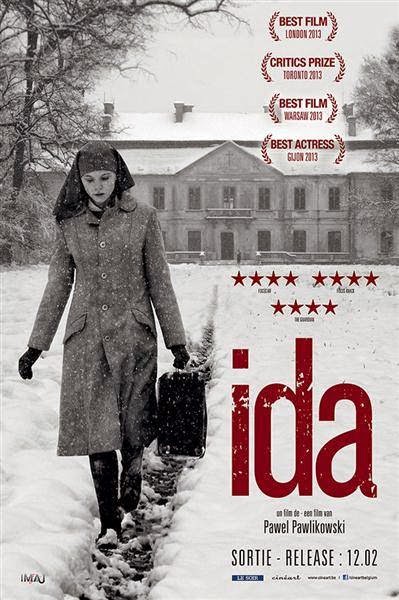
For Your Consideration... Ida


Last month, the Polish co-production (also produced by Denmark, France, and the UK, with support from the Council of Europe film fund, Eurimages) Ida, directed by Paweł Pawlikowski, took home the 2015 Oscar for Best Foreign Language Film at the 87th Academy Awards. Ida beat out one of the favorites, Russia’s Levithian, as well as Mali’s first and only Oscar nominee to date, Timbuktu.

Ida is a very artistic film, reminiscent of the style of many European films from the 1960s (as the movie is set in the same time period). Instead of showing a scene in a straight-forward frame, this movie uses extremely daring camera angles…many scenes are crooked, characters are not centered and their faces and bodies are awkwardly cut off in many frames, and settings, such as staircases, take the camera’s focus away from what is actually happening. If you are looking for very artsy direction, this is probably the film for you. It’s also in black & white, adding an extra ounce of avant garde in case you needed more. However, I will say that the black & white helps set the mood for the
                                                             drab and depressing tone of post-WWII Poland.
 
Apart from the visual aspect, Ida tells the story of Ida, a young woman who is preparing to become a nun. Before she takes her final vows, she is told that she should learn about her roots first. Ida and her only surviving relative, her aunt, a communist judge, go on a journey to rediscover a haunting past and what unknowingly led Ida to become part of the Catholic Church in the first place.

One of the artistic liberties Ida takes with a staircase.
Ida touches on many post-war European values and experiences, most of the reason why I believe this film got so much acclaim. Living in the Polish People’s Republic, a satellite to the Soviet Union, not even twenty years after the end of World War II, Ida loses her past, as she never had the opportunity to learn about it, amidst all the violence and displacement. As a viewer, you can feel the sorrow that exists in these characters’ worlds and you get to experience what they are learning about themselves for the first time. Ida meets people from with complicated pasts and blurry futures as she is discovering her own past and trying to reconcile her future.

Wednesday, January 28, 2015

If You Like "The Crucible", You Will Love...

The Hunt – Denmark & Sweden (2012)


The Hunt represented Denmark at both the 2014 Academy Awards & 2014 Golden Globe in the Best Foreign Language Film category. Lucas, played by Mads Mikkelsen (seen in Casino Royale), is a kindergarten teacher in a small Danish town. While waiting to be picked up after school one day, one of the children says some very damning things about Lucas. In a small town, news travels fast, and before Lucas knows it, all those close to him shun him. Lucas is faced with day-to-day ridicule in a situation that he seems to be stuck in permanently.


Directed by Thomas Vinterberg, this film does an amazing job at exposing Lucas' inner turmoil on screen. As the Star Tribune puts it, "It’s a contemporary horror story about a respected man’s descent into a Kafkaesque nightmare of denunciations, dread and danger." The Hunt also features some great cinematography in the Danish film tradition and is something that shouldn't be missed. 

Monday, December 29, 2014

Joyeux Noël

Directed by Christian Carion

France, Germany, United Kingdom, Belgium & Romania (2005)


Premiering at the Cannes Film Festival, Joyeux Noël was nominated for rewards at several major film industry competitions, such as the Academy Awards & Golden Globes of the United States, the British BAFTA Awards, and the French César Awards. The film is a European co-production based upon the true story of the Christmas truce that took place during World War I. 

From 1914 to 1918, the Great War was raging on in Europe, which saw many casualties and a change in how war was fought. In the early 1900s, nations were eager to go to war with their new technologies and assumed that battles would be battles between machinery.  Being the first modern war to use technologies such as army tanks, trenches, and mustard gas, over 16 million people, both soldiers and civilians, lost their lives. As a result, many soldiers returned home with scaring experiences to a public who didn't fully understand how the way war was fought changed. 

Lewis, Brühl, and Boon
in their roles as Scottish,
German, and French leaders
On the Western front during December 1914, the three forces who were fighting against each other, France, Germany, & Great Britain, agreed upon a ceasefire to celebrate Christmas Eve. This ceasefire brought together the officers and soldiers of opposing armies and allowed them to celebrate with football games, singing of Christmas carols, and to exchange stories and food items from their homelands. The story of the Christmas truce illustrates the very human side of war and how these competing nations could put aside their differences for celebration. Joyeux Noël tells this story with the talents of Diane Kruger, Guillame Canet, Benno Fürmann, Dany Boon, Gary Lewis, and Daniel Brühl, who can all be seen in many other great films.

Friday, October 24, 2014

COMING SOON!

Movies Without Borders will be moving to movieswithoutborders.com !

Stay tuned!!!

If You Like "Weekend at Bernie's", You Will Love...

Waking Ned Devine – United Kingdom/France (1998)

Waking Ned Devine is a hilarious movie that takes place in the Irish countryside. A lotto winner is announced in the town of Tully More, a town with just over 50 residents. It should be pretty easy to find out who won that lotto and then be extra nice to them so that they will give you some of the winnings, right? Think again.

As parties are thrown and schemes are created to figure out who the lotto winner could be, two friends and one of their wives successfully figure out who the winner is... It's Ned Devine! But the problem is that Ned is dead. And smart enough to write his name on the back of the winning ticket. So now how can anyone else claim the prize money? Simple: by pretending to be Ned Devine. And then getting the entire town to support your impersonation.  

Shot on the Isle of Man, this under-the-radar co-production is filled with many great moments and jokes, especially if you're a fan of British comedy. And if you're searching for it outside of North America, you'll find it under the title, Waking Ned.


Tuesday, September 30, 2014

Chungking Express

Directed by Kar Wai Wong

Hong Kong (1994)


Chungking Express takes place in the streets of Hong Kong in the 1990s. It tells the tales of two different love stories; in the first, a cop known as He Qiwu, deals with a breakup and falls for a mysterious drug dealer, and in the second, another cop known only as Cop 663, deals his breakup with a flight attendant while trying to win the affections of Faye, a counter girl at the Chungking Express. The two storylines don't necessarily intersect in a big reveal at the end of the movie, but they show how closely separated people actually are and how people's paths can just miss intersecting with each other.

One of my favorite things about the film is the dialogue. It is filled with many memorable lines that make you laugh or think but are not too painstakingly witty. For example, the mysterious woman that He Qiwi falls in love with (yes, she is so mysterious that she doesn't even have a name), always walks around wearing sunglasses and a raincoat, two very opposite pieces of clothing. She says, "I don't know when I started being so cautious. If I put on a raincoat, I wear sunglasses too. You never know if there's going to be rain or shine."
 
Several film reviewers & critics have compared this film to the French New Wave cinema era. Quentin Tarantino even liked the film so much that he was able to get Miramax to distribute it in the United States. Visually, the film is beautifully done, filled with lots of colors, filters, and visual effects, and all these features are not shown in an over-the-top, "I'm trying to be artsy" fashion. The storylines are not anything too unrealistic either, but show a day-in-the-life portrait without all the frills of a blockbuster movie.

Chungking Express is a very well-done portrait of Hong Kong in the 90s. And as a bonus feature, there is a great cover of The Cranberries' hit song, Dreams, once you make it all the way to the end.

Thursday, August 28, 2014

If You Like Wes Anderson, You Will Love...

Micmacs – France (2009)

If you've seen the French modern classic Amélie (with the true French title being Le Fabuleux Destin d'Amélie Poulain), you might have an idea of what to expect from this movie. If you have not, you can expect a quirky side of humor with some bizarre characters and situations much like any Wes Anderson movie.

Micmacs is the story of Bazil, a video store employee who is shot by a stray bullet one night on the job. He survives and decides to live life as everyday is his last, as the bullet was not removed from his skull, and it could kill him at any moment. While street performing, an onlooker sees Bazil and takes him to a junkyard, Tire-Larigot. There, he meets a whole group of outcasts with very bizarre talents and backgrounds, ranging from a contortionist and human cannon ball all the way to a guillotine survivor. Bazil decides that he wants to take revenge on the weapons company whose bullet hit him in the head (and whose weapons killed his father many years ago). His new friends refuse to let him live at Tire-Larigot if they cannot help him, and as the French translation of the title suggests, many shenanigans ensue.

Comedian Dany Boon as Bazil.
Clearly by the above description, this is not your typical movie. Very bizarre and quirky, it is not a drama by any means, but a very ironic tale. And while you watch this, you can ponder the following question: How do you bring down a weapons dealer when they have all the weapons?

Monday, July 28, 2014

Trainspotting

Directed by Danny Boyle

Scotland (United Kingdom) (1996)


The British Film Institute considers Trainspotting to be one of the top British films of all time, and it is probably the most-highly acclaimed film coming from the country of Scotland. (Scotland is a part of the island of Britain, and Britain is a state in the United Kingdom, making Scotland British by association even though it is considered its own country.) The cult classic revolves around the lives of heroin addicts in the late 1980s in Edinburgh. The title, Trainspotting, has nothing to do with watching trains (although there is a scene in the movie where the characters wait on a train platform, and there is a wallpaper print with trains all over it), but has to do with using heroin. A frequent user of heroin will have a series of spots that resemble train tracks on their arms from injecting the drug into their system. The movie is based on the novel of the same name written by Irvine Welsh.

Literally, trainspotting.
Trainspotting follows the life of Renton (Ewan McGregor) who is involved in the Scottish drug scene. All of Renton’s friends are fellow drug addicts, and they find themselves in lots of compromising situations while trying to get money to continue funding their addictions. Renton finally tries to get himself out of the drug scene but finds it difficult as he keeps associating with the same influential friends and remembering how good the high of the drugs feel. The film shows the many effects of the drug, both the highs and the lows, and the desperate actions the characters will take to continue their habit.

Trainspotting documents the increased drug epidemic in the 1980s Edinburgh neighborhood of Leith. Edinburgh was a popular haven for drugs, dating all the way back to the late 1600s, and in the 1800s, it was one of the world’s highest producers of opiates. Drug use was popular among the middle classes and those with money. The 1970s saw high rates of unemployment, and the 1980s brought in cheap heroin from Pakistan, making it easier for people with less money to purchase the drug. Because of the unemployment rates, people felt they had nothing to work towards, making drugs a more attractive time killer.* Edinburgh then not only saw a drug epidemic, but also a surge in communicable diseases such as hepatitis B & C, as well as HIV.**

Even though this movie is in English, I had to watch it with subtitles because of the heavy Scottish accent. It is not for the queasy of heart as some parts are pretty graphic, but it is a great commentary on the world of drug addiction. As a viewer of the movie, you feel like you are experiencing the constant high that these characters are going through. Part comedy, part drama, part crime film, it is a very well-crafted movie.

* http://www.theguardian.com/society/2009/aug/15/scotland-trainspotting-generation-dying-fact
** http://www.heraldscotland.com/news/home-news/the-fatal-legacy-of-a-nations-drug-use-epidemic.18619037

Monday, June 30, 2014

Infernal Affairs

Directed by Andrew Lau & Alan Mak (2002) 

Hong Kong


Infernal Affairs is the Hong Kong film that inspired Martin Scorsese's Oscar-winning film, The Departed, so if you liked that one, it is only natural that you give this one a shot. Infernal Affairs is the classic story of a gangster and an undercover cop. But this time, there is a police mole in the gang and there is a gang mole in the police force. The question is, which one of them will discover the other one first?

The English title for this film is not the Cantonese title, The Unceasing Path. Infernal Affairs was chosen for the English title because the corruption in the police force is an internal affair. The original Cantonese title references the lowest level of hell in Buddhism, so the word infernal plays on that. If you try to look up the movie Internal Affairs, you will have a little trouble finding this title. 

Hollywood has the Walk of Fame,
and Hong Kong has the Avenue
of Stars with this statue of Bruce Lee.
(nexusholidays.com)
This movie is one of the successful examples of the many films that are being produced in Hong Kong. Hong Kong has become a hub for film production due to its geographic location. The cinema is popular with nearby Asian nations, and because there are so many great stories being featured in their cinema, Hong Kong films are gaining popularity in countries like the United States. More and more recognition is being paid to Hong Kong films on the international circuit, and Hollywood has their eyes set on remaking a lot of these movies for their own market. In many cases, film fans want to see the original film, allowing them to find great foreign movies like this one. This was the first film from Hong Kong I have seen, and I know I will be looking for more. No wonder Hong Kong’s film industry made $26 million USD from film exports in 2012.

If you like this title, also be sure to check out the two sequels, Infernal Affairs 2 & Infernal Affairs 3. I haven't gotten a chance to view them, but if they are anything like Infernal Affairs, they will be worth a watch.

Bonus Material: If you have seen The Departed, look out for the Boston Red Sox hat in one of Infernal Affairs' scenes. Is it just a coincidence that The Departed was set in Boston?

Tuesday, June 10, 2014

If You Like "Escape from Alcatraz" or "The Rock", You Will Love...

Le Trou (The Hole) – France (1960)

Le Trou is the French grand-père of Escape from Alcatraz and great grand-père of The Rock. It takes place inside a Parisian prison in 1947 where cellmates are trying to plan an escape. Whether or not they successfully make it out of the prison, you will have to find out for yourself. But this movie is now included on my top twenty-five list of all time.

My favorite thing about this movie is the minimalism. While there isn’t too much dialogue and absolutely no CGI or special effects, I sat in suspense the entire time I was watching this, wondering if the inmates would be caught as they explored the inner workings of the prison. As a viewer, you feel like you are right there with them, except for the fact you are lucky enough to be eating from a bowl of popcorn on your couch.